Saturday, November 3, 2007

Bigger, Smaller, Cheaper, Better Flash MP3 Players


Music and video lovers reap the benefits as portable media players increase in capacity and decrease in size and price.

Each year around this time the portable media player landscape changes. With Apple leading the charge by completely revamping its offerings, competitors vie to devise players they hope will slay the almighty iPod. While Apple, Archos, and Microsoft still remain committed to hard disk players, many manufacturers have abandoned them in favor of higher-capacity flash players. Since flash devices are more com
pact and durable, and maximum capacities and now stretched to 16 GB, many are making the move to flash. The good news is that there's a bountiful product (and price) range to choose from.

Link to the article.

Top store raided for selling triad T-shirt


Sales staff suspected of breaking anti-gang law

Police yesterday arrested 18 people from the upmarket lifestyle and homeware retail chain G.O.D. for selling T-shirts and postcards printed with the Chinese characters for "14K" - the name of a major triad society.

The action raised concern among some cultural commentators, who questioned whether it threatened freedom of expression.

However, others - including a fashion designer and human rights activist - blamed the chain store for testing the limits of the law.

Acting Superintendent Paul Cheng Fuk-chuen of the Organised Crime and Triad Bureau warned those who had bought the T-shirts not to wear them because by doing so they would break the law and could face penalties of up to seven years' jail and a HK$250,000 fine.

"Anyone who is found in possession or control of any symbol relating to any triad society is breaking the law," he said. "I think the [design] industry has the responsibility to check [the law]. If necessary, they should seek legal advice."

Mr Cheng also warned the media not to publish the full name of the society, and to blur the characters on the T-shirt in photos.

But the name of 14K, and other triad societies, can be found with detailed descriptions on police and other government websites - and in the press release giving details of yesterday's arrests.

Hong Kong Journalists Association chairwoman Fan Ho-tsai said the practice of not using a triad society's full name in news reports had long been abandoned. But she believed the gangs should not be publicised unless absolutely necessary.

Nine men and nine women, including shopowner Douglas Young, a designer, salespeople and other G.O.D. staff members were arrested on suspicion of violating the Societies Ordinance. They were all released on bail last night. No one has been charged.

A total of 88 T-shirts and more than 500 postcards were seized during lunchtime raids on the chain's shops in Causeway Bay, Central and Tsim Sha Tsui, as well as its offices and warehouse in Yuen Long. The T-shirts sold for HK$280 and the postcards HK$5 each.

G.O.D. marketing manager Cherry Ma Kit-ling said the design was not meant to draw any connection to the triad society and the company found such accusations frustrating.

"The sales of the T-shirt are not even good," she said. Less than one-fifth of the 100 T-shirts produced had been sold since mid-September. Buyers of the T-shirts can get a refund or call the police on 2527 7887.

Former film producer and scriptwriter Jimmy Pang Chi-ming said the arrests amounted to white terror.

"Something we have never taken seriously could in fact land us in jail."

Cultural commentator Leung Man-to said police were overreacting and it would not lead to self-censorship among the creative media.

But fashion designer William Tang said there was a difference between artworks with triad elements and those that sold them as a brand.

"A lot of movies and dramas centre on the rituals and life of triad members. But it is a different matter to display a triad name as a brand."

Human rights activist Law Yuk-kai said G.O.D. might have gone too far with its T-shirt. "The postcard is all right though, it reads 14K Gold, not just 14K."

Thursday, November 1, 2007

Losses from pay TV piracy down 15pc with use of secure network


Pay TV piracy in Hong Kong is estimated to result in total losses of HK$213 million this year, down 15 per cent from last year, a poll has found.

The industry expects losses will be further cut as more subscribers pay for the service through the highly secured internet protocol television service (IPTV), according to the survey conducted by the Cable and Satellite Broadcasting Association of Asia and Standard Chartered Bank.

Simon Twiston Davies, the association's chief executive officer, said yesterday: "The IPTV platform is much tougher for pirates and this helps channel operators retain integrity in distributing the content. It is more difficult to hack the system."

The survey also found that total estimated losses in the regional pay TV service due to piracy would be US$1.54 billion this year, up from US$1.13 billion a year earlier.

"The net cost of piracy reduced 15 per cent over the same period last year due to competition driving service charges down," Lee Beasley, director of Standard Chartered Bank (Hong Kong), said.

Legitimate pay TV users in Hong Kong number about 1.45 million. Illegitimate users remain at about 118,000, the same as last year, of which 98,000 are connected through illegal set-top boxes and 20,000 receive satellite overspill signals from satellite receiver dishes. Mr Beasley said the Hong Kong government was estimated to suffer tax losses of US$4.62 million this year, according to PricewaterhouseCoopers figures.

Mr Twiston Davies said: "We don't expect piracy to have dramatic changes in Hong Kong; it is stable as Hong Kong is a competitive market."

He said the pay TV market in the city benefited from market competition. Subscribers were on the rise because of new player PCCW's Now TV pushing the service aggressively by securing exclusive rights to English Premier League football matches from this year to 2010.

His association, which represented 128 Asian-based corporations, took legal action last year against commercial distributors of unauthorised signals in public venues such as pubs during the World Cup football matches, he said.

"In China, there were cases where a whole cable platform was pirated on the internet," he said. "We feel optimistic as China is an evolving market and pay TV will be protected in the medium term."

Earlier this year, the association called on the Hong Kong government to make all illicit broadcasting a criminal offence instead of imposing civil remedies on those using illegal satellite feeds.

Redd Samonte, supervisor of East End Brewery, a sports pub in Causeway Bay, said the government should adopt harsher measures on the illicit screening of sports games.

The pub attracts many football or rugby fans every night to watch matches broadcast by Cable TV and Now TV.

"The situation would be much improved as long as the pubs know they are taking a huge risk if they use unauthorised satellite feeds."

Wednesday, October 31, 2007

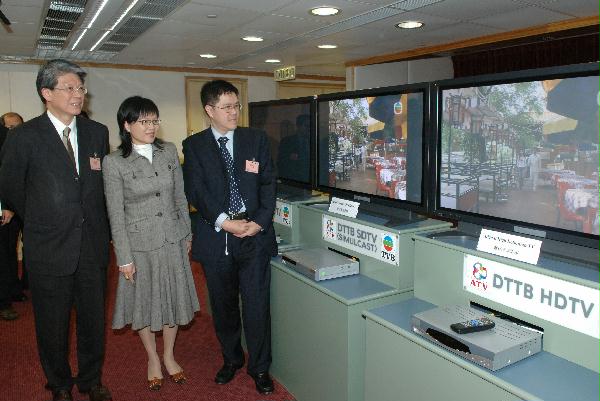
Digital TV transition ‘complete by 2012’


Hong Kong’s broadcast industry would be able to completely move over from analogue to digital terrestrial television (DTT) broadcasting by 2012, Financial Secretary John Tsang Chun-wah said on Wednesday.
“The government is working closely with the two local terrestrial broadcasters, [Asia Television] and [Television Broadcasts (SEHK: 0511)], as well as TV equipment manufacturing and trading industry as well as the community to ensure a smooth transition,” Mr Tsang told the opening ceremony of the Cable and Satellite Broadcasting Association of Asia (CASBAA) Convention.

“We announced plans to switch to DTT back in 2004 and the local broadcasters have been ironing out ever since details and upgrading equipment to deal with the switch-over,” he explained.

Mr Tsang said the success of the project depended on co-operation from all stakeholders – consumers, broadcasters and electronics industry and the government.

But the financial secretary said the emergence of new media also brought new challenges for the industry. He suggested introducing tighter regulations.

“Apart from making sustained efforts in law enforcement and public education, we seek to keep our copyright law under regular review to ensure that it is completely up to date.

“The next item on our agenda is how best to enhance copyright protection in the digital environment,” Mr Tsang said.

He added that combating piracy required a public-private partnership and commended the collaborative efforts of CASBAA and local pay television operators in taking civil action against commercial and domestic pirated viewing under the Broadcasting Ordinance and Copyright Ordinance.

He said: “Several recent high profile cases have served good public education purposes. The pirates need to know that we are on their tails and we are serious about beating them hard.”

Mr Tsang also highlighted plans to set up a committee to formulate new strategies to ensure the progress of the territory’s creative industries.

“One of our initiatives, something we call ‘Hong Kong on location’, is intended to promote the city as a setting for films,” he said.

In the last budget, the government earmarked HK$300 million for a new fund aimed to help finance film production – attracting more talents from the mainland and overseas to film in Hong Kong.

Saturday, October 27, 2007

$8,500 per class in grants for IT equipment


The government plans to give a one-off cash injection of HK$200 million for schools to upgrade information technology in their classrooms.

The proposal was yesterday welcomed by educators, but they urged the government to allow the schools flexibility in how they spent the money.

In a consultation paper on utilising information technology, the Education Bureau proposed granting the money to about 1,000 government-owned or government-subsidised primary and secondary schools to purchase computers and other equipment.

Senior curriculum development officer Ching Kwok-chu said the money would be commensurate with the number of classes in each school.

"We estimate each class will get about HK$8,500," he said. "We will stick to this rule even if there are only two classes in a school. We won't set a minimum amount."

He expected schools would use up the money in about three years.

Edith Tse Lai-man, headmistress of the Jordan Road Government Primary School, said the grant would be "just barely enough".

"I hope the government will lift restrictions on how to spend the money," she said.

Ms Tse's school has 18 classes and would likely get a grant of HK$153,000 under the proposal.

Besides buying more computers and visualisers - electronic imaging tools for displaying 3-D objects, artwork, printed material or live subjects - Ms Tse said she hoped to use the money to hire another IT technician, which was not allowed under the proposal.

Li Chi-shing, IT teacher at Po Leung Kuk Chee Jing Yin Primary School, welcomed the plan, but also called on the government to let schools decide how to use the money.

Education Bureau principal assistant secretary Eddie Cheung Kwok-choi said the scheme would be made as flexible as possible and schools' suggestions would be considered.

Under the Composite Information Technology Grant, a secondary school with 25 to 30 classes can get HK$294,499 a year for IT expenses, while a whole-day primary school receives HK$279,366 a year.

The government also plans to spend HK$25 million to develop an online database of teaching materials organised according to the school curriculum.

Parents will also benefit, with the government proposing to spend HK$1 million commissioning NGOs to develop resources and programmes to raise parents' computer literacy. A HK$5 million grant will be given to maintain the ITeHelp hotline, which provides technical support for schools.

Mr Cheung said the government would also scrap the IT matching-fund scheme, which has long been criticised by educators who said it had widened the gap between the haves and the have-nots.

The dollar-for-dollar plan was introduced in 2004 to improve IT infrastructure in schools. Schools must raise donations, which the bureau matches.

The public can give feedback to the Education Bureau until November 28. The government will also hold five consultation sessions for school management committee members, school heads, teachers and parents next month. The plans are to be confirmed by next January.

Friday, October 26, 2007

Lost in translation


Have you ever noticed the signs that you encounter on a daily basis? The English they use can be really awful. There is a website www.engrish.com which has all sorts of funny English people have come across in different countries.

If you are interested in doing some further reading, there is a review of the book "Lost in Translation" which is about different English signs from non English speaking countries.

Enjoy!